France saw a new Prime Minister in Mr Edouard Balladur after the crushing defeat of the Socialist Party over two rounds of legislative elections. The writing had loomed large on the wall after the first round of elections. And despite much speculation that President Mitterrand might not even consider an RPR Prime Minister, Monsieur Balladur was duly named in a televised appearance by the wily President.
The European issue was placed firmly as a central plank in the elections by the former Prime Minister Pierre Beregovoy. The defeat of his party can only herald an hardening of French attitudes towards aspects of the European issue, and towards some important global issues such as the Uruguay Round of trade talks.
Next door in Italy, the cleansing out of corrupted politicians and senior citizens continued unabated. The wave of scandals has flushed out many in the establishment. Former Minister of Agriculture Gianni Fontana was replaced on 23 March for illegal party financing. Even Prime Ministers – past and present – were not exempted. Former PM Giulio Andreoti was under investigation for his presumed links with the Mafia. The current PM Amato had to have a tȇte-à-tȇte with President Scalfaro; and his government was facing increasing risk by the end of the month.
Even Denmark, the current holder of the EC Presidency, didn’t escape the political turmoil. There, the former Minister of Justice Pia Gjellerup had to resign because of the imminent collapse of a professional training centre of which she was president before becoming a minister.
In Denmark, of course, the Maastricht Treaty is still the subject for much agonizing amongst the populace. The barometer for political opinion there was certainly variable during the month. At the end of March, the ‘yes’ votes had dropped in the Danish polls vis-à-vis the 53% polled earlier in the month. This came about even after a lot of optimism had been expressed in the earlier part of the month by both former PM Anker Joergensen and incumbent Poul Nyrup Rasmussen, who had made a strong plea for a ‘yes’ to the Treaty.
The UK is the other Member State which is still in the throes of trying to determine whether or not to accept the Maastricht Treaty. At the end of the month, after a marathon session of 22 hours, the government was confident that the debate on the ratification of the Treaty would be concluded by the end of July. This confidence was certainly absent earlier in the month when the government suffered a defeat when a Labour amendment on the procedures for regional voting was put to the vote.
When even the self-controlled Belgians had to succumb to the turmoil, it can only be concluded that the degree of agitation must have been, not only serious, but also infectious. In Brussels, this only-recently-declared capital of the EC, PM Dehaene tendered his resignation due to a lack of consensus on his budget proposals. But he was still in office at the end of the month. Evidently, King didn’t accept his resignation. In the European Parliament, before 69 of its privileged members made their annual pilgrimage to warmer climes, in Botswana this time, for the ACP/EC Joint Assembly meeting, debates certainly ranged far and wide. Perennial issues of racism in Europe and measures to tackle it, and Human Rights everywhere and placing respect for it as a conditionality for EC aid, were indeed prominent. Also prominent were the ‘feminization’ of EC institutions, the widening of the European citizenship to include foreigners who can vote, and the extremely knotty subject of proportional representation vis-à-vis a single-member constituency system. This last issue is of course critical for MEPs who will be facing elections in June 1993.
MEPs also celebrated the 40th anniversary of the EP on 11 March. But they were also diligent in reminding themselves that whilst they talked and debated about the enlargement of the EC, they should not do so at the cost of neglecting to accede to the Maastricht Treaty.
The ubiquitous ACP issues never fail to surface in the EC circle. They certainly did in March. Some of the 69 MEPs, for instance, were castigating the ACP members of the Joint Assembly for reversing the decision to invite President De Klerk to the Botswana meeting. Given some credit, however, were Malawi for the decision by its President-for-Life to hold a referendum next June to determine the country’s future political agenda; and Madagascar for successfully completing its Presidential election. On the debit side was Rwanda whose numerous violations of human rights were condemned.
Taking the brunt of a mild ticking-off by an ACP country, for a change, was France. The leader of the Zaire opposition said France was very weak indeed for failing to respond effectively to the government when a French diplomat was fatally shot in Kinshasa recently. Kenya, on the other hand, brought everyone’s attention to the harsh reality of the situation being experienced by that country, and submitted to the EC for an increase in aid which could be deployed for the accommodation of the 420,000 refugees from Somalia, Ethiopia and Sudan, who have found their way to the country.
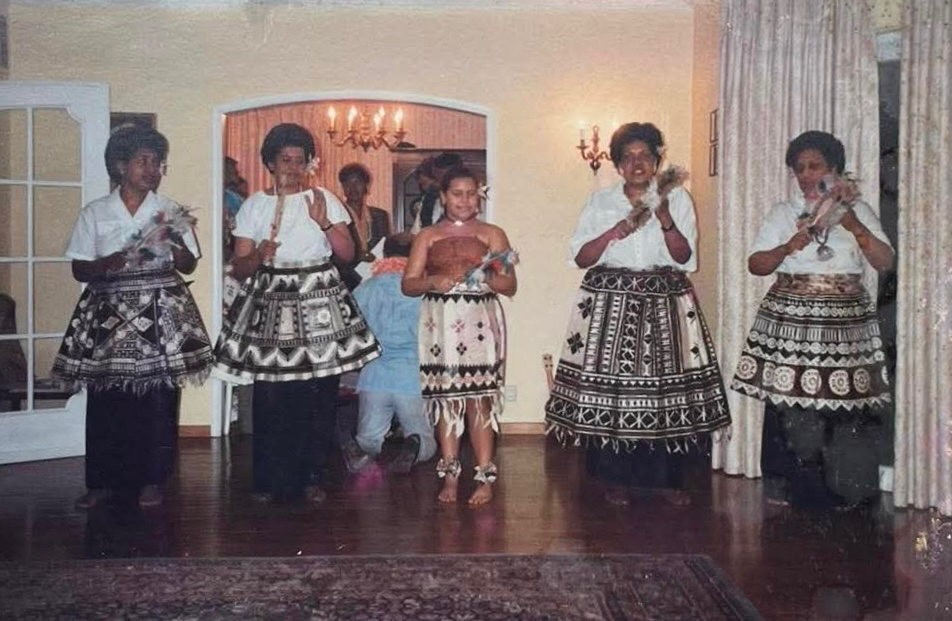
IMAGE CREDIT: A Bula evening at the Ambassadorial residence to raise funds for Hurricane Kina relief, February 1993.
 kaidravuni